Dmodel Multi-Material Optimization Example
This page introduces the Dmodel_multi_material project.
Unlike the Dmodel project, Dmodel_multi_material performs multi-material topology optimization. It optimizes the distribution of three materials in the rotor core: air, magnetic core, and permanent magnet.
Base mesh
The Dmodel_multi_material project uses a base mesh whose rotor contains only material ID 20 (magnetic core), without permanent magnets.
By setting material ID 20 as the design target, the multi-material distribution is optimized throughout the rotor.
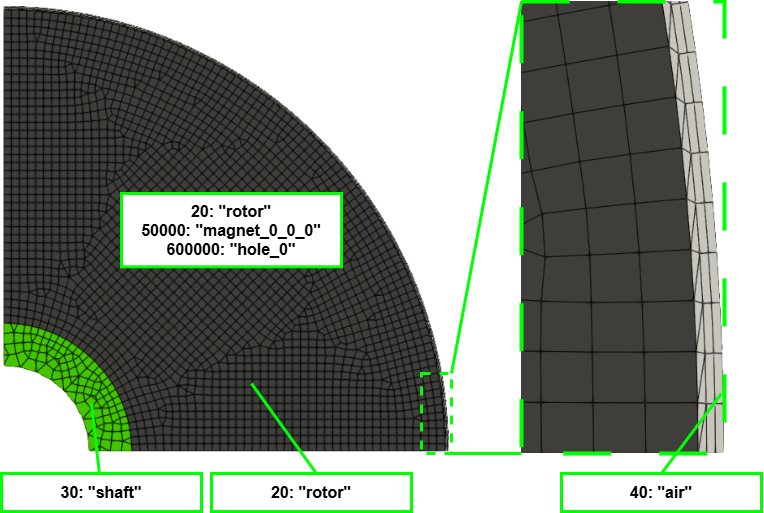
machine.yaml (Dmodel_multi_material project)
To configure multi-material optimization, set the three material IDs machine.yaml, target_ids_and_onoff, and 20 in 50000 > 600000.
This enables the level_set_function to configure the three materials.
target_ids_and_onoff:
  20:
    - 20
    - 50000
    - 600000
Implicit Domain Meshing cannot be used when three or more materials are specified.
optimization.yaml (Dmodel_multi_material project)
In optimization.yaml, specify level_set_function as the ngnet_multi_material.
ngnet_multi_material is an implementation example that sets three levels at each location in the design region based on the design variables. See Docs > User Guide > ngnet_multi_material for details about its arguments.
level_set_function:
  name: ngnet_multi_material
  kwargs:
    sigma: 0.0020
    design_region: [[0.008, 0.0275], [0, 45.0]]
    coordinate: Polar
    angle_1: 240
    angle_2: 60
:::tip Configuring angle_1 and angle_2
angle_1 and angle_2 represent the angles assigned to the magnetic core and permanent magnet on the material map. The angle assigned to air is [deg].
ngnet_multi_material makes a material more likely to appear in the design region when it is assigned a larger angle on the material map [12]. Because the rotor of a permanent-magnet synchronous motor generally consists mostly of magnetic core, angle_1, corresponding to the magnetic core, is intentionally set to a large value here.
:::
optimization_problem.yaml (Dmodel_multi_material project)
The objectives are unchanged from the Dmodel project: maximize average torque and minimize torque ripple.
The change is the addition of ineq_constraint (the area of a specified material) to material_area. Set physical_tag (permanent magnet) as 50000.
This optimization constrains the permanent-magnet area to no more than the original Dmodel value (), seeking an optimal material distribution while using no more permanent magnet than the original.
objectives:
  - function_name: average_torque
    kwargs:
      torque_scale: 4.0
    normalization_const: 2.1
    coefficient: -1.0
  - function_name: torque_ripple_percentage
    kwargs:
      torque_scale: 4.0
    normalization_const: 54.0
    coefficient: 0.1

ineq_constraints:
  - function_name: material_area
    kwargs:
      physical_tag: 50000
    baseline: 4.9975e-05
Optimization example
This example runs for 200 optimization iterations.
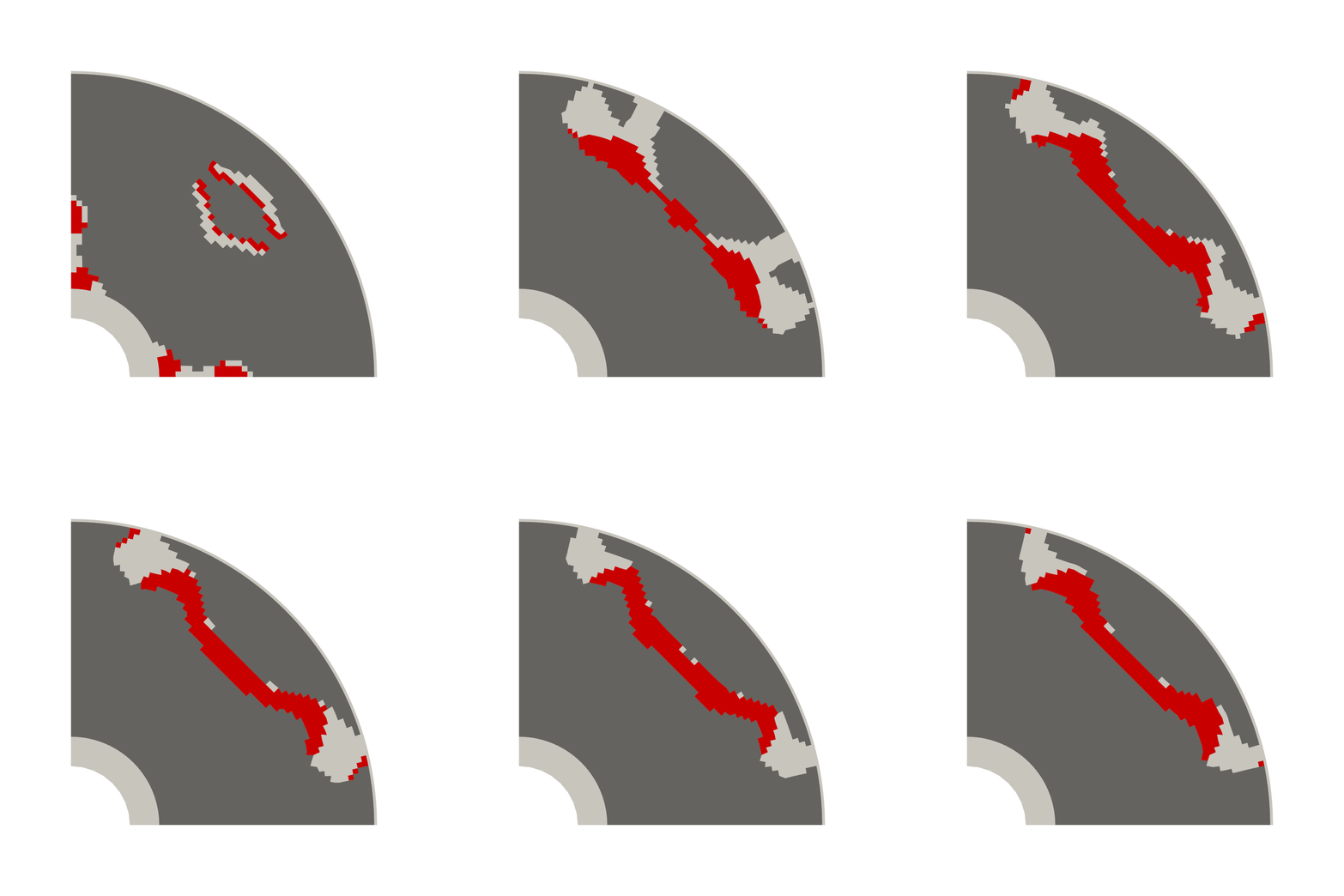
The figure below shows the shape evolution over 200 iterations, with the best shape at each iteration animated. The air/magnetic-core/permanent-magnet distribution changes and converges toward a single-layer permanent-magnet and flux-barrier shape.
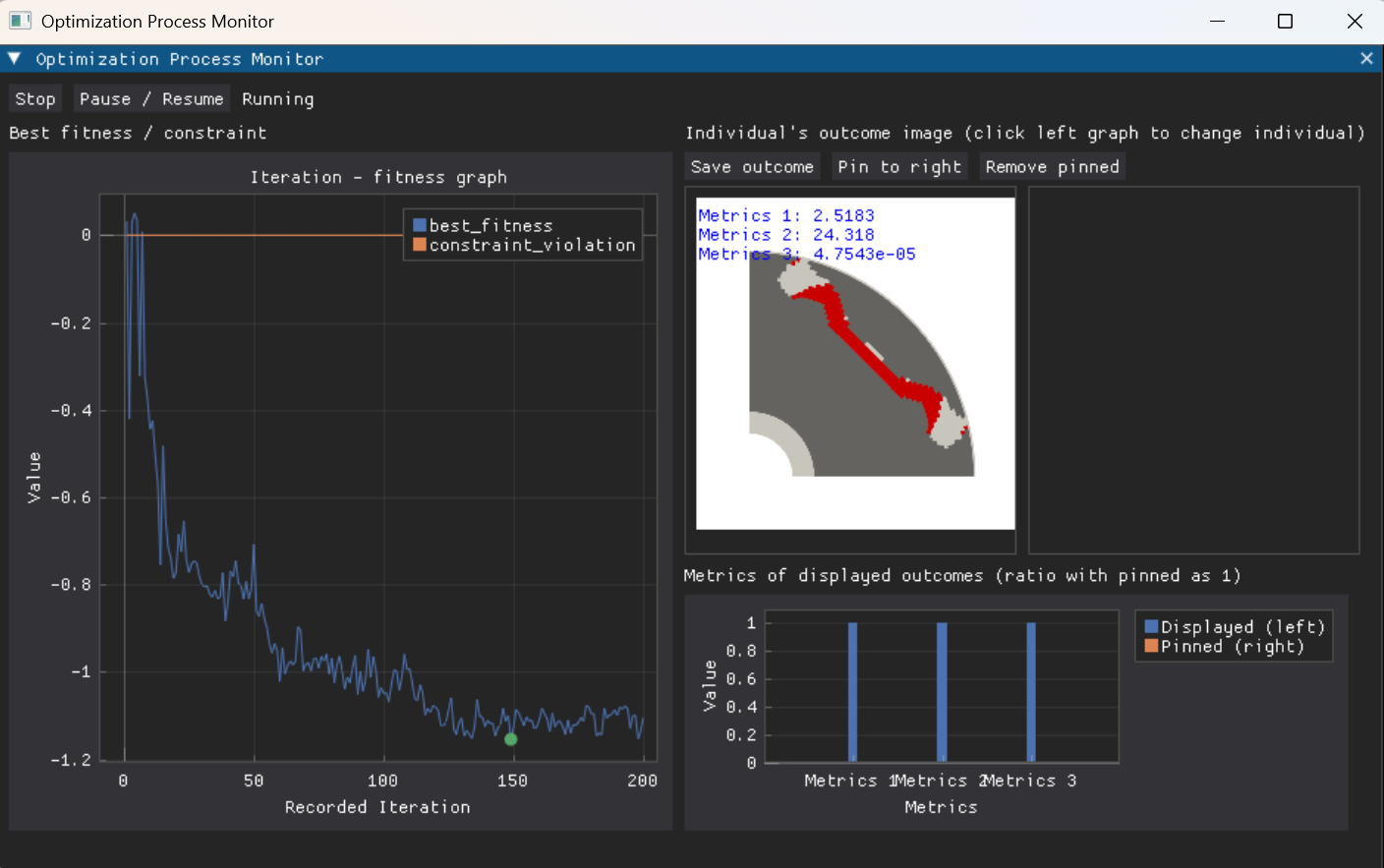
The GUI after 200 iterations is shown below.
Although convergence is slower than in the other examples, the objective values are nearly flat after iteration 130, indicating convergence.
The best shape shown in the GUI has =2.5183 Nm, =24.318%, and permanent-magnet area . Compared with the basic optimization, average torque improves substantially. In multi-material optimization of permanent-magnet motors, the permanent magnets can be reshaped, which is known empirically to make improvements in average torque easier to achieve. Conversely, it is also possible to minimize permanent-magnet area while constraining average torque to remain above a specified level.