IPM8P48S Description and Basic Optimization Example
This page describes IPM8P48S and introduces the contents of the IPM8P48S_moo project.
Model description
IPM8P48S is an eight-pole, 48-slot (distributed-winding) interior permanent magnet synchronous motor (IPMSM) virtual model. It is one of the motor models proposed in reference [16] and is based on a motor for automotive drive systems.
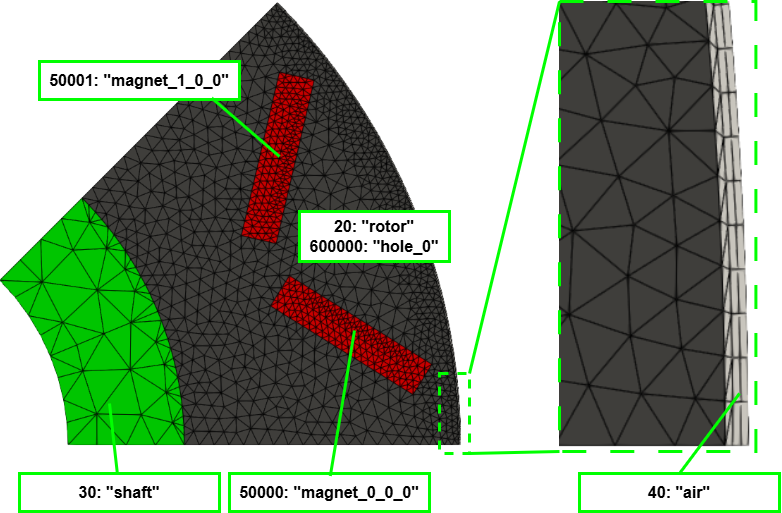
The mesh included with the IPM8P48S_moo project is an eighth model, and material information (material ID: material name) is assigned to each region.
The figure below shows the rotor model and material information. For topology optimization, the air holes (flux barriers) in the original model have been filled with rotor core.
machine.yaml (IPM8P48S_moo project)
First, examine machine.yaml, which configures the machine information.
Basic settings
IPM8P48S is defined by radius and angle in the Polar coordinate system.
coordinate: Polar
IPM8P48S is a half-pole-symmetric model.
has_sym_region: True
The symmetry axis is at 22.5° from the x-axis.
sym_deg: 22.5
There is no rotationally symmetric region in the eighth model.
num_rotate: 0
Material settings
Here, the design target is the rotor core (material ID 20), with the following settings.
- ON-state material → rotor core (material ID 20)
- OFF-state material → air hole (material ID 600000)
target_ids_and_onoff:
  20:
    - 20
    - 600000
The material IDs and names are assigned as follows.
physical_id_to_name:
  20: rotor
  30: shaft
  40: airgap
  50000: magnet_0_0_0
  50001: magnet_1_0_0
  600000: hole_0
This is the material-ID map for the symmetric region. Permanent magnet 50000 becomes 50001 across the symmetry axis, so this mapping is configured here. The other materials do not change across the symmetry axis and are mapped to the same IDs.
mirror_id_map:
  20: 20
  30: 30
  40: 40
  50000: 50001
  600000: 600000
Because there is no rotationally symmetric region, increment_info is empty.
increment_info: {}
Implicit Domain Meshing options
Implicit Domain Meshing is enabled by default.
use_implicit_domain_meshing: True
Regions other than the design target (20: rotor) are not split.
no_split_ids:
  - 30
  - 40
  - 50000
  - 50001
The sliding-mesh region (40: air) is also placed in no_remesh_ids because it must not be remeshed.
Remeshing this region would make the mesh inconsistent with the stator side.
no_remesh_ids:
  - 40
The mesh-quality-related settings are assigned appropriate values.
design_region_size: 0.04
hausd_ratio: 0.0001
hmin_ratio: 0.02
Finally, the evaluation-skip threshold is set to 0.02. Compared with Dmodel, IPM8P48S is more likely to generate flattened elements during optimization, so a somewhat lower threshold is used here to prioritize optimization performance.
bad_mesh_threshold: 0.02
optimization.yaml (IPM8P48S_moo project)
Next, examine optimization.yaml, which configures the optimization.
Because this is a multi-objective shape optimization, the multi-objective decomposition_ensemble algorithm is selected. See the corresponding documentation page for details.
evaluator:
  name: pyemsol_shape_evaluator
optimizer:
  name: decomposition_ensemble
  kwargs:
    num_decomposition: 5
    seed: 42
The ngnet level-set function is used to perform topology optimization with the NGnet on/off method.
level_set_function:
  name: ngnet
  kwargs:
    sigma: 0.003
    design_region: [[0.040, 0.0802], [0, 22.5]]
    coordinate: Polar
This example uses 100 optimization iterations.
Parallel processing is enabled by default.
num_iteration: 100
enable_parallelization: True
num_processes: Null  # if Null, automatically set from cpu counts
(Output-related settings are omitted.)
optimization_problem.yaml (IPM8P48S_moo project)
case_names:
  - transient

objectives:
  - function_name: average_torque
    kwargs:
      torque_scale: 8.0
    normalization_const: 14.62
    coefficient: -1.0
  - function_name: torque_ripple_percentage
    kwargs:
      torque_scale: 8.0
    normalization_const: 35.34
    coefficient: 1.0

ineq_constraints:
  - function_name: average_torque
    kwargs:
      torque_scale: 8.0
    coefficient: -1
    baseline: 14.62

eq_constraints:
  - function_name: num_connected_components
    kwargs:
      physical_tag: 20
    baseline: 1

other_metrics:
  - function_name: average_torque
    kwargs:
      torque_scale: 8.0
  - function_name: torque_ripple_percentage
    kwargs:
      torque_scale: 8.0
The multi-objective optimization problem is defined below. It considers both average torque and torque ripple, while constraining average torque not to fall below the original-model value of 14.62 Nm. The rotor-core connectivity constraint is also considered.
: average torque [Nm]
: torque ripple [%]
: number of connected components
Optimization example
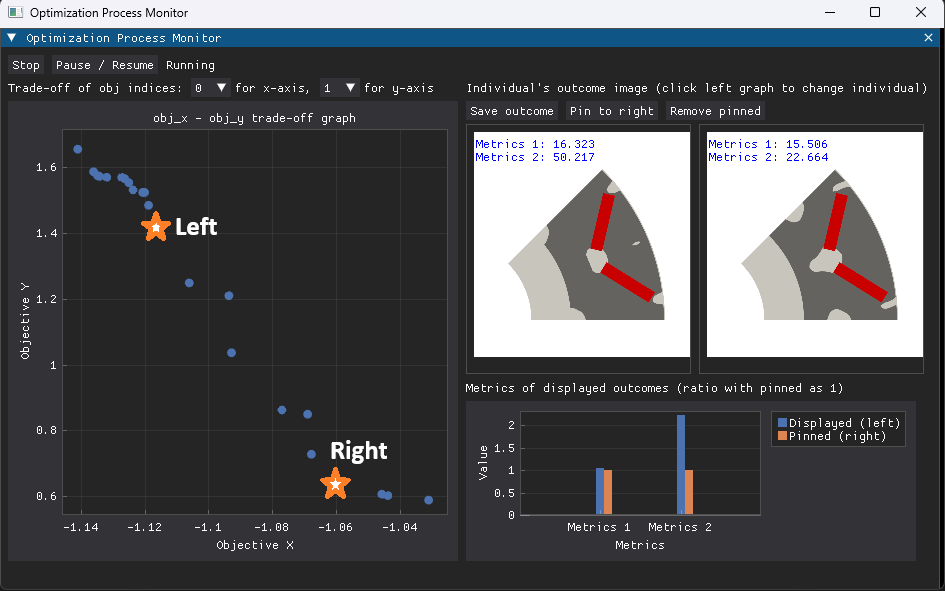
The GUI after 100 optimization iterations is shown below. A relatively broad and uniform Pareto front is obtained.
The example shapes shown are the solutions labeled "Left" and "Right" in the Pareto-front plot. Their flux-barrier arrangements are similar, but the rotor-surface-side flux barriers differ. The "Right" solution has elongated flux barriers and offers a relatively good balance between average torque and torque ripple. In contrast, the "Left" solution has semicircular flux barriers arranged to confine the magnetic flux, suggesting a high-torque motor.