MagneticShield_3D Optimization
This page introduces the MagneticShield_3D project.
Model description
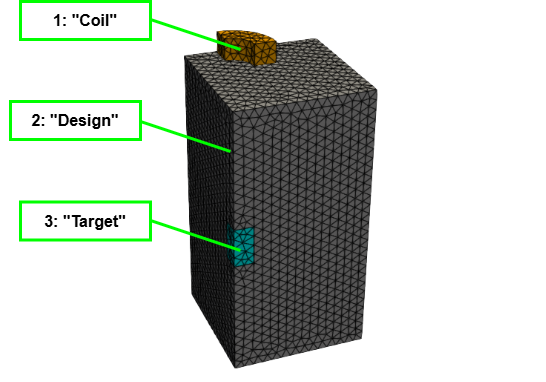
MagneticShield3D is a model of a three-dimensional magnetic-shield structure (original model: reference [34]).
The protected region, 3: "Target", is surrounded by 2: "design", a magnetic material with a linear relative permeability of 200, to prevent magnetic fields from entering it.
This project optimizes the magnetic-material structure using the NGnet on/off method.
machine.yaml (MagneticShield3D project)
First, examine machine.yaml, which configures the machine information.
Basic settings
This is a three-dimensional analysis, and the optimization target is pre_geom.msh. Unlike the motor examples, the model has no sliding-motion region, so this is the only input mesh. The coordinate system is Cartesian (xyz).
# analysis dimension
analysis_dimension: 3D

# design target: "pre_geom" or "rotor"
design_target: pre_geom

# coordinate system: 'Cartesian' or 'Polar'
coordinate: Cartesian
The analysis region contains no line-symmetric or rotationally symmetric region.
# whether design region includes symmetric region
has_sym_region: False
Material settings
The design target is the magnetic shielding material (material ID 2):
- On-state material → magnetic material (material ID 2)
- Off-state material → air hole (material ID 600000)
# on/off material information
target_ids_and_onoff:
  2:
    - 2
    - 600000
The following assigns material IDs to names. IDs 6–9 are assigned to the coil surfaces for defining current sources in pyemsol.
ID 4 is a thin air layer placed between 2: Design and 4: Air for the Implicit Domain Meshing operation described below.
physical_id_to_name:
  1: Coil
  2: Design
  3: Target
  4: Air
  5: layer
  6: Coil_top
  7: Coil_outer
  8: Coil_bottom
  9: Coil_inner
  600000: Hole
Implicit Domain Meshing option
Implicit Domain Meshing is enabled by default.
use_implicit_domain_meshing: True
Regions other than the design target (2: Design) are not split.
# material boundaries of no_split_ids will be preserved after remeshing
no_split_ids:
  - 1
  - 3
  - 4
  - 5
  - 6
  - 7
  - 8
  - 9
The coil and surrounding air should not be remeshed, so they are listed in no_remesh_ids.
# mesh of no_remesh_ids will be preserved after remeshing
no_remesh_ids:
  - 1
  - 4
  - 6
  - 7
  - 8
  - 9
In this configuration, 2: Design is remeshed and contacts 3: Target and 4: Air.
Because 4: Air contacts 1: Coil, it is configured not to be remeshed.
To connect the remeshed 2: Design result to the fixed mesh of 4: Air, a thin air layer (5: layer) that permits remeshing is placed between them.
Mesh-quality-related settings are assigned appropriate values.
# approximate design region size
design_region_size: 1.0

# hausd option ratio to design region size
# stands for maximum Hausdorff distance (approximation error) for level set boundaries
hausd_ratio: 0.001

# hmin option (minimum size of mesh) ratio to design region size
hmin_ratio: 0.01
Finally, the evaluation-skip threshold is set to 0.001.
# if mesh quality (>= 0, <= 1) is less than bad_mesh_threshold after remeshing, the individual will be skipped
bad_mesh_threshold: 0.001
optimization.yaml (MagneticShield3D project)
Next, examine optimization.yaml, which configures the optimization.
Because this is a single-objective shape optimization, cmaes is specified as the optimizer.
The level_set_function is set to ngnet, which places Gaussian basis functions over [[0, 0.140], [0, 0.140], [0, 0.140]], which contains the design region.
# optimization dependencies
evaluator:
  name: pyemsol_shape_evaluator
optimizer:
  name: cmaes
  kwargs:
    seed: 42
level_set_function:
  name: ngnet
  kwargs:
    sigma: 0.04
    design_region: [[0, 0.140], [0, 0.140], [0, 0.140]]
    dimension: 3D
    coordinate: Cartesian
This example uses 100 optimization iterations.
Parallel processing is enabled by default.
num_iteration: 100
enable_parallelization: True
num_processes: Null  # if Null, automatically set from cpu counts
(Output-related settings are omitted.)
optimization_problem.yaml (MagneticShield3D project)
case_names:
  - static

objectives:
  - function_name: magnetic_energy
    kwargs:
      physical_tag: 3
    normalization_const: 1.0e-14
    coefficient: 0.5
  - function_name: material_volume
    kwargs:
      physical_tag: 2
    normalization_const: 0.002744
    coefficient: 0.5

ineq_constraints: []

eq_constraints: []

other_metrics:
  - function_name: magnetic_energy
    kwargs:
      physical_tag: 3
  - function_name: material_volume
    kwargs:
      physical_tag: 2
The optimization problem minimizes magnetic_energy (the magnetic energy in protected region 3) and material_volume (the amount of magnetic material used).
Optimization example
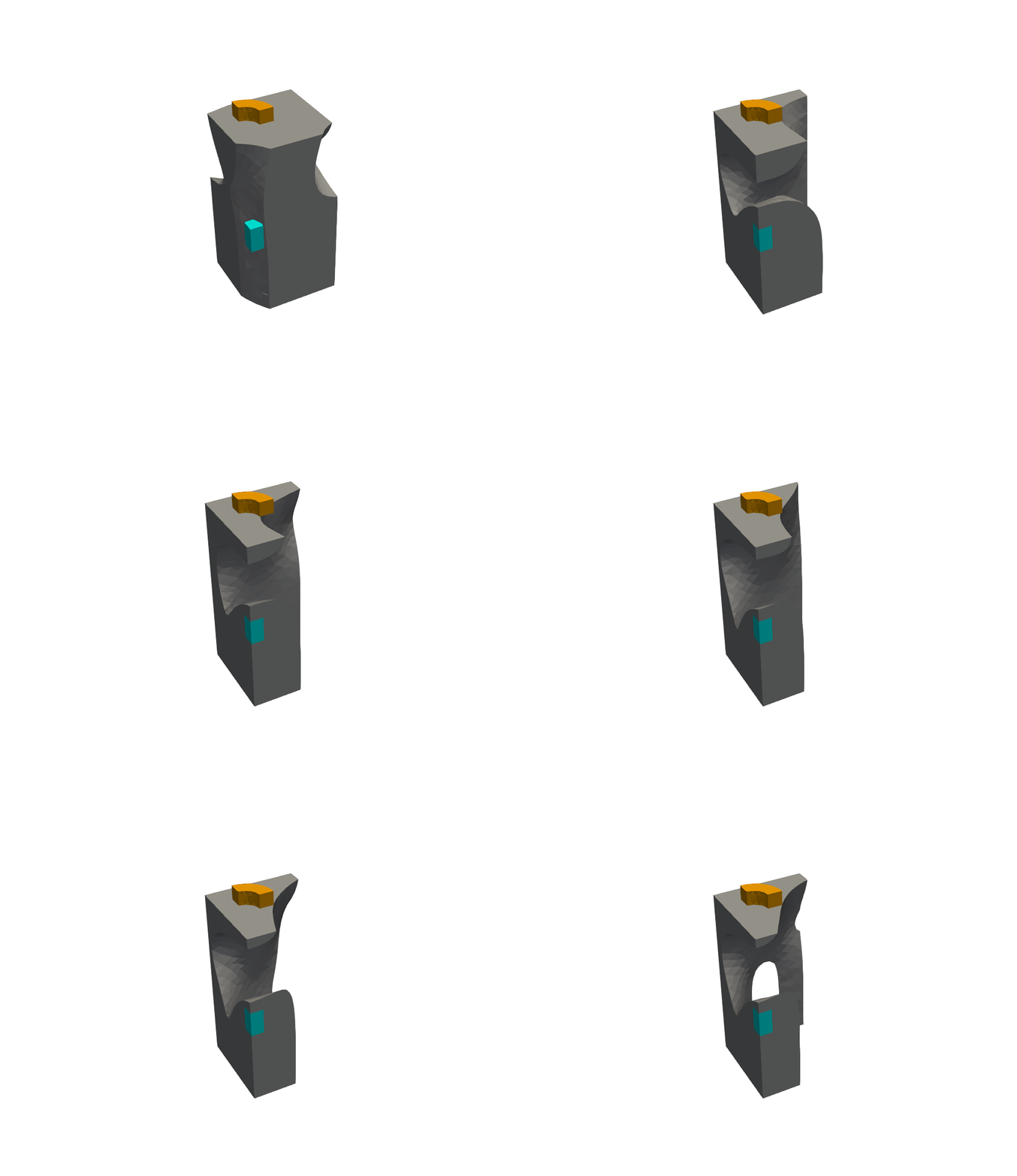
The optimization progress is shown below. An approximately two-layer magnetic-material structure is obtained.
The magnetic material has a three-dimensional rather than axisymmetric structure, showing that the optimization reduces the amount of magnetic material used.
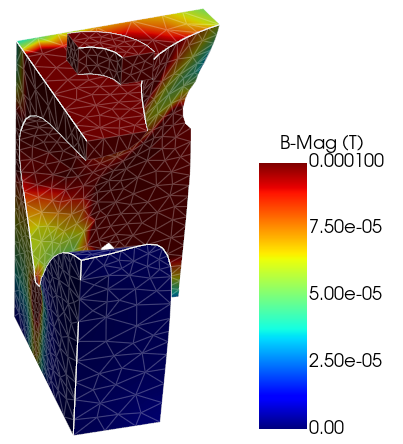
The magnetic-flux-density distribution in the optimized structure is shown below, visualized with pyemsi. Most of the flux passes through the outer layers, protecting the target region.