sample_line()
Sample mesh data along a straight line.
Creates a line probe from pointa to pointb with the specified resolution and samples the mesh data onto each point along the line. For temporal datasets, automatically sweeps all time points unless time_value is specified.
Parameters
pointa(Sequence[float]) — Starting point[x, y, z]of the line.pointb(Sequence[float]) — Ending point[x, y, z]of the line.resolution(int, default:100) — Number of segments to divide the line into. The resulting line will haveresolution + 1points.time_value(float | None, default:None) — Query a specific time value instead of sweeping all time points. Ignored for static datasets.tolerance(float | None, default:None) — Tolerance for the sample operation. IfNone, PyVista generates a tolerance automatically.
Returns
Returns a list of dictionaries (one per time step) with a "time" key and array names as keys. Each array has:
- For scalars:
"distance","value","x","y","z"(sample point coordinates) - For vectors:
"distance","x_value","y_value","z_value","tangential"(component along path),"normal"(component perpendicular to path),"x","y","z"(sample point coordinates)
For static datasets, returns a single-element list with time 0.0.
[
    # Time 0 (or single time for static)
    {
        "time": 0.0,
        "scalar_name": {
            "distance": [0.0, 0.1, 0.2, ...],
            "value": [val0, val1, val2, ...],
            "x": [x0, x1, x2, ...],
            "y": [y0, y1, y2, ...],
            "z": [z0, z1, z2, ...]
        },
        "vector_name": {
            "distance": [0.0, 0.1, 0.2, ...],
            "x_value": [x0, x1, x2, ...],
            "y_value": [y0, y1, y2, ...],
            "z_value": [z0, z1, z2, ...],
            "tangential": [t0, t1, t2, ...],
            "normal": [n0, n1, n2, ...],
            "x": [x0, x1, x2, ...],
            "y": [y0, y1, y2, ...],
            "z": [z0, z1, z2, ...]
        },
        ...
    },
    # Time 1
    {"time": 0.01, ...},
    ...
]
Examples
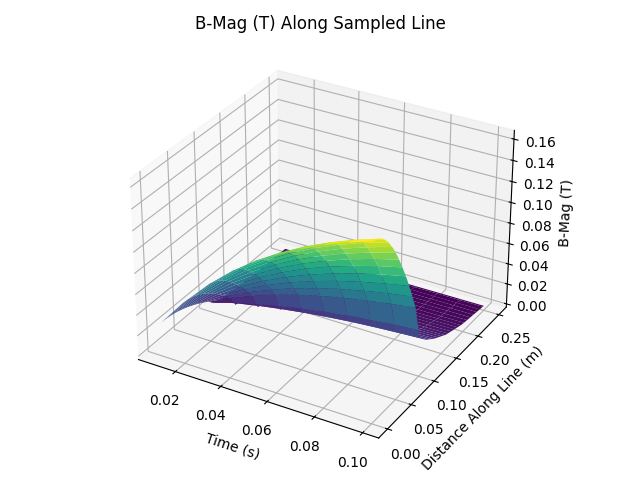
Sweep all time steps
from pyemsi import Plotter, examples
from matplotlib import pyplot
import numpy as np

file_path = examples.transient_path()
plt = Plotter(file_path)

data = plt.sample_line(pointa=(0.02, 0.02, 0.0), pointb=(0.02, 0.02, 0.25), resolution=100)

time_values = [time_data["time"] for time_data in data]
distances = data[0]["B-Mag (T)"]["distance"]
value_grid = np.array([time_data["B-Mag (T)"]["value"] for time_data in data])
time_grid, distance_grid = np.meshgrid(time_values, distances, indexing="ij")

fig, ax = pyplot.subplots(subplot_kw={"projection": "3d"})
ax.plot_surface(time_grid, distance_grid, value_grid, cmap="viridis")
ax.set_xlabel("Time (s)")
ax.set_ylabel("Distance Along Line (m)")
ax.set_zlabel("B-Mag (T)")
ax.set_title("B-Mag (T) Along Sampled Line")
fig.tight_layout()
fig.savefig("docs/static/demos/sample_line.png")
Plot three time slices
from pyemsi import Plotter, examples
from matplotlib import pyplot

file_path = examples.transient_path()
plt = Plotter(file_path)

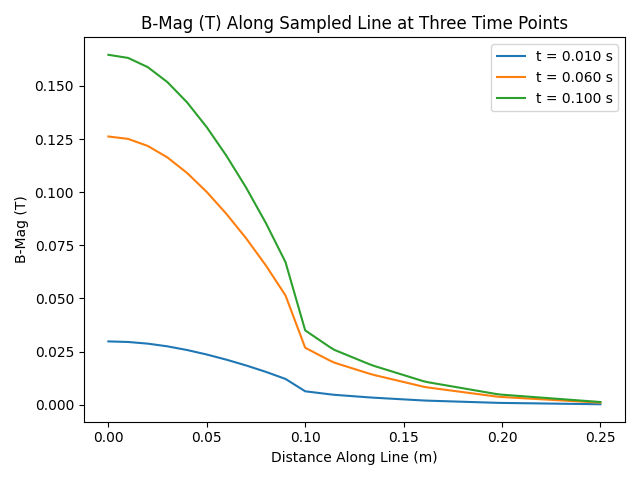
data = plt.sample_line(pointa=(0.02, 0.02, 0.0), pointb=(0.02, 0.02, 0.25), resolution=100)
time_indices = sorted({0, len(data) // 2, len(data) - 1})

fig, ax = pyplot.subplots()
for idx in time_indices:
    ax.plot(
        data[idx]["B-Mag (T)"]["distance"],
        data[idx]["B-Mag (T)"]["value"],
        label=f"t = {data[idx]['time']:.3f} s",
    )
ax.set_xlabel("Distance Along Line (m)")
ax.set_ylabel("B-Mag (T)")
ax.set_title("B-Mag (T) Along Sampled Line at Three Time Points")
ax.legend()
fig.tight_layout()
fig.savefig("docs/static/demos/sample_line_time_slices.png")
See Also
sample_lines()— Sample along multiple linessample_arc()— Sample along a circular arcsample_point()— Sample at a single point coordinate