
VI-2. Post Files#
EMSolution writes distribution data files. Specify the file format with POST_DATA_FILE(10.2) in Section 10.2, Output Files.
For standard file formats (other than CADAS and HyperView output), each distribution quantity is written to a separate file.
For CADAS output, all distribution quantities are written in CADAS format to the single post.cad file. Specify POST_DATA_FILE=6 to use CADAS format. You can use the result as a CADAS input file by concatenating the separately written post_geom mesh file before this file. The following lists physical-quantity names (VNAME) in CADAS files.
For HyperView output, as with CADAS output, all distribution quantities are written in HyperView format to the single post.hwascii file.
File magnetic#
MAGNETIC(10.3) writes magnetic flux density distributions. The unit of magnetic flux density is \(T \, (Wb/m^2)\).
<When ELEM_OUT(10.2) =1 is specified in the input file>
Element quantity (evaluated at the element centroid)
Magnetic flux density x-component (B-X)
Magnetic flux density y-component (B-Y)
Magnetic flux density z-component (B-Z)
Magnetic flux density magnitude (B-SQR)
<When NODE_OUT(10.2) =1 is specified in the input file>
Nodal quantity (magnetic flux density is the simple average of values at nodes of elements connected to the node)
Magnetic flux density x-component (B-X)
Magnetic flux density y-component (B-Y)
Magnetic flux density z-component (B-Z)
Magnetic flux density magnitude (B-SQR)
Magnetic flux (Wb)* (FLUX)
Written for two-dimensional calculations ( GEOMETRY(12) =1 or 2).
For
GEOMETRY(12)=1: magnetic flux passing throughDELTA_Z_THETA(12).For
GEOMETRY(12)=2: magnetic flux passing throughDELTA_Z_THETA(12)* r.
Here, DELTA_Z_THETA(12) is defined in the input file. See the following figure.
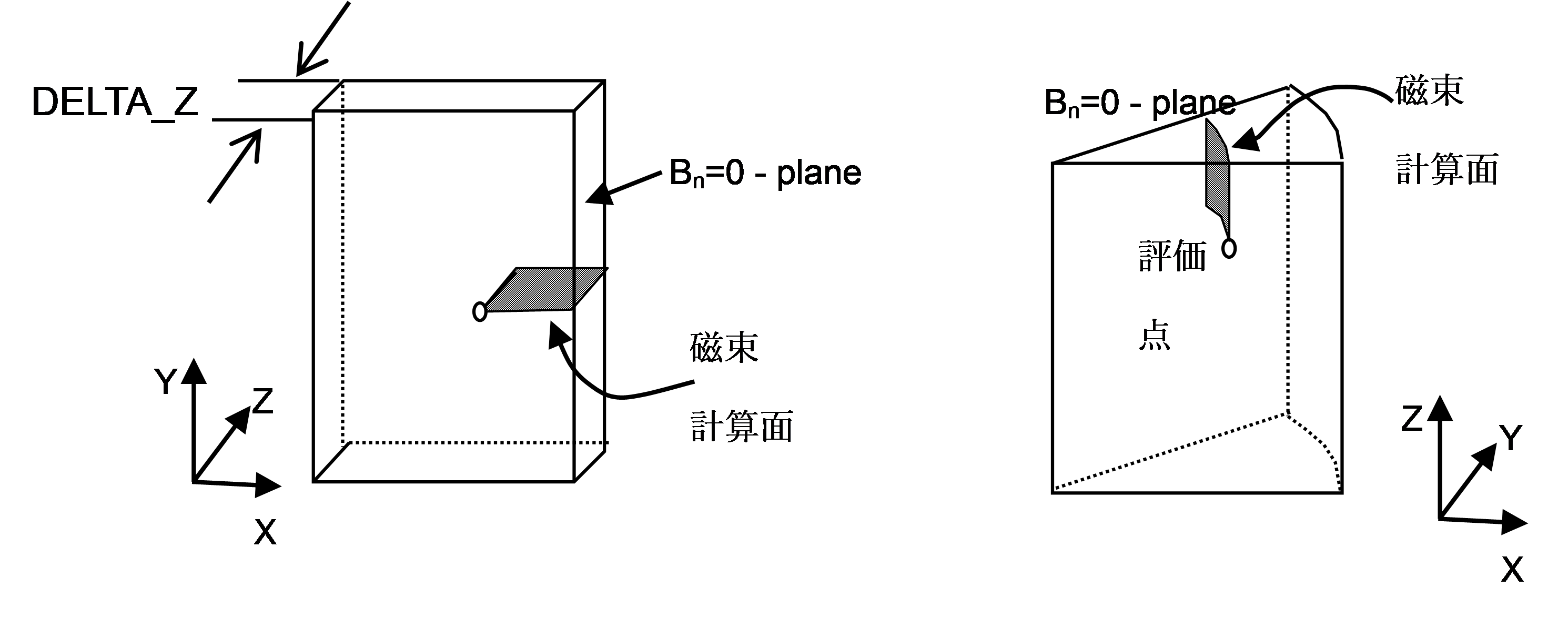
Magnetic-flux calculation surface for two-dimensional calculations#
File current#
CURRENT(10.3) writes current density distributions. The unit of current density is \(A/m^2\). Output is produced for conductor regions (eddy-current regions and regions specified by ELMCUR(17.2), SDEFCOIL(17.3), PHICOIL(17.4), DCCURR(17.5), or SUFCUR(17.6)).
<When ELEM_OUT(10.2) =1 is specified in the input file>
Element quantity (evaluated at the element centroid)
Current density x-component (J-X)
Current density y-component (J-Y)
Current density z-component (J-Z)
Current density magnitude (J-SQR)
Joule heat-generation distribution (W/m3) (Q)
<When NODE_OUT(10.2) =1 is specified in the input file>
Nodal quantity (the simple average of values at nodes of conductor elements connected to the node)
Current density x-component (J-X)
Current density y-component (J-Y)
Current density z-component (J-Z)
Current density magnitude (J-SQR)
Joule heat-generation distribution (W/m3) (Q)
File surface_current#
SURFACE_IMPEDANCE(16.2) writes current density distributions for surface-impedance surfaces. The unit is \(A/m\); this is surface current density, representing current integrated in the direction normal to the surface.
<When ELEM_OUT(10.2) =1 is specified in the input file>
Element quantity (evaluated at the element centroid)
Current density x-component (JS-X)
Current density y-component (JS-Y)
Current density z-component (JS-Z)
Current density magnitude (JS-SQR)
Joule heat-generation distribution (W/m2) (Q)
<When NODE_OUT(10.2) =1 is specified in the input file>
Nodal quantity (the simple average of values at nodes of impedance-surface elements connected to the node)
Current density x-component (JS-X)
Current density y-component (JS-Y)
Current density z-component (JS-Z)
Current density magnitude (JS-SQR)
File force#
FORCE_NODAL(10.3) writes electromagnetic forces calculated by the nodal-force method.
<When ELEM_OUT(10.2) =1 is specified in the input file>
Element quantity (nodal forces are distributed to elements connected to the node, excluding air, with volume weighting)
Electromagnetic force x-component (NFOR-X)
Electromagnetic force y-component (NFOR-Y)
Electromagnetic force z-component (NFOR-Z)
Electromagnetic force magnitude (NFOR-SQR)
<When NODE_OUT(10.2) =1 is specified in the input file>
Nodal quantity (writes nodal force in \(N\))
Electromagnetic force x-component (NFOR-X)
Electromagnetic force y-component (NFOR-Y)
Electromagnetic force z-component (NFOR-Z)
Electromagnetic force magnitude (NFOR-SQR)
File surface_force#
Writes nodal electromagnetic forces calculated by the nodal-force method for surface elements when FORCE_NODAL(10.3) =3.
Nodal quantity (writes nodal force in \(N\))
Electromagnetic force x-component (NFOR-X)
Electromagnetic force y-component (NFOR-Y)
Electromagnetic force z-component (NFOR-Z)
Electromagnetic force magnitude (NFOR-SQR)
File force_J_B#
FORCE_J_B(10.3) writes electromagnetic forces calculated by volume integration of the Lorentz force.
<When ELEM_OUT(10.2) =1 is specified in the input file>
Element Quantity
Electromagnetic force x-component (LFOR-X)
Electromagnetic force y-component (LFOR-Y)
Electromagnetic force z-component (LFOR-Z)
Electromagnetic force magnitude (LFOR-SQR)
<When NODE_OUT(10.2) =1 is specified in the input file>
Nodal quantity (writes nodal force in \(N\))
Electromagnetic force x-component (LFOR-X)
Electromagnetic force y-component (LFOR-Y)
Electromagnetic force z-component (LFOR-Z)
Electromagnetic force magnitude (LFOR-SQR)
File heat#
HEAT(10.3) writes heat-generation density and heat generation in each element. For transient analysis, it writes values at each step (AVERAGE(10.2) =0) or time-averaged values (AVERAGE(10.2) =1). For AC steady-state analysis, it writes values at each output phase (AVERAGE(10.2) =0) or values averaged over one cycle (AVERAGE(10.2) =1).
<When HEAT(10.3) =1 is specified in the input file>
Element Quantity
Heat-generation density (W/m3) (HEAT-DEN)
Heat generation (W) (HEAT-VOL)
Writes each element’s element ID, material-property ID, centroid XYZ coordinates (m), and element-average heat generation (W/m3).
File surface_heat#
HEAT(10.3) writes the average heat generation of each surface-impedance element over one cycle when the surface-impedance method is used in AC steady-state analysis (HEAT(10.3) =1 and AVERAGE(10.2) =1). Heat generation in each element is volume-integrated.
Element Quantity
Surface heat-generation density (W/m2) (SHEAT-DEN)
Heat generation (W) (SHEAT-VOL)
File disp#
DISP(10.3) writes displacements of each node in the moving part for analyses that include motion (when DISP(10.3) =1).
Nodal Quantity
Displacement x-component (m) (DISP-X)
Displacement y-component (m) (DISP-Y)
Displacement z-component (m) (DISP-Z)
Displacement magnitude (m) (DISP-SQR)
File magnetization#
MAGNETIZATION(10.3) writes element magnetization or magnetic field strength, and demagnetization ratio and permeance coefficient when MAGNET(17.7) is used.
<When MAGNETIZATION(10.3) =1 is specified in the input file>
Writes magnetization as an element quantity in \(T \, (Wb/m^2)\).
Magnetization x-component (M-X)
Magnetization y-component (M-Y)
Magnetization z-component (M-Z)
Magnetization magnitude (M-SQR)
<When MAGNETIZATION(10.3) =-1 is specified in the input file>
Writes magnetic field strength as an element quantity in \(A/m\).
Magnetic field strength x-component (M-X)
Magnetic field strength y-component (M-Y)
Magnetic field strength z-component (M-Z)
Magnetic field strength magnitude (M-SQR)
<When MAGNETIZATION(10.3) =2 is specified in the input file>
Writes the demagnetization ratio and permeance coefficient (\(H\)) as element quantities.
Demagnetization ratio (M-X)
Permeance coefficient (M-Y)
File electric#
E(10.3) writes electric potential, electric flux density, electric field strength, and current density distributions. Units are \(V\), \(C/m^2\), \(V/m\), and \(A/m^2\), respectively.
Written for electrostatic analysis (STATIC(2) =2) when CURRENT(10.3) =1.
<When ELEM_OUT(10.2) =1 is specified in the input file>
Element quantity (evaluated at the element centroid)
Electric flux density x-component (D-X)
Electric flux density y-component (D-Y)
Electric flux density z-component (D-Z)
Electric flux density magnitude (D-SQR)
Electrostatic energy density (J/m3) (E-DEN)
Note: For implementation reasons, electrostatic energy density uses the same value as electric potential for NODE_OUT.
<When NODE_OUT(10.2) =1 is specified in the input file>
Nodal quantity (the simple average of values at nodes of elements connected to the node)
Electric flux density x-component (D-X)
Electric flux density y-component (D-Y)
Electric flux density z-component (D-Z)
Electric flux density magnitude (D-SQR)
Electric potential \((V)\) (V)
Written for electrostatic analysis (STATIC(2) =2) when CURRENT(10.3) =2.
<When ELEM_OUT(10.2) =1 is specified in the input file>
Element quantity (evaluated at the element centroid)
Electric field strength x-component (E-X)
Electric field strength y-component (E-Y)
Electric field strength z-component (E-Z)
Electric field strength magnitude (E-SQR)
Electrostatic energy density (J/m3) (E-DEN)
Note: For implementation reasons, electrostatic energy density uses the same value as electric potential for NODE_OUT(10.2).
<When NODE_OUT(10.2) =1 is specified in the input file>
Nodal quantity (the simple average of values at nodes of elements connected to the node)
Electric field strength x-component (E-X)
Electric field strength y-component (E-Y)
Electric field strength z-component (E-Z)
Electric field strength magnitude (E-SQR)
Electric potential \((V)\) (V)
Written for steady current-field analysis (STATIC(2) =3) when CURRENT(10.3) =1.
<When ELEM_OUT(10.2) =1 is specified in the input file>
Element quantity (evaluated at the element centroid)
Current density x-component (J-X)
Current density y-component (J-Y)
Current density z-component (J-Z)
Current density magnitude (J-SQR)
Joule heat-generation distribution \((W/m^3)\) (Q)
<When NODE_OUT(10.2) =1 is specified in the input file>
Nodal quantity (the simple average of values at nodes of elements connected to the node)
Current density x-component (J-X)
Current density y-component (J-Y)
Current density z-component (J-Z)
Current density magnitude (J-SQR)
Electric potential \((V)\) (V)
File iron_loss#
To calculate iron loss with IRON_LOSS(10.3), first specify the iron-loss calculation method (IRON_LOSS(11)).
<When IRON_LOSS(11) =1 or 2 and IRON_LOSS(11) =1 are specified in the input file>
Writes loss in \(W\) and loss density in \(W/kg\) as element quantities.
Lamination-direction eddy-current loss density (\(W/kg\)) (EL-DEN)
Lamination-direction eddy-current loss (\(W\)) (EL-VOL)
Hysteresis loss density (\(W/kg\)) (HL-DEN)
Hysteresis loss (\(W\)) (HL-VOL)
<When IRON_LOSS(11) =1 or 2 and IRON_LOSS(11) =2 are specified in the input file>
Writes loss in \(W\) and loss density in \(W/m^3\) as element quantities.
Lamination-direction eddy-current loss density (\(W/m^3\)) (EL-DEN)
Lamination-direction eddy-current loss (\(W\)) (EL-VOL)
Hysteresis loss density (\(W/m^3\)) (HL-DEN)
Hysteresis loss (\(W\)) (HL-VOL)
<When IRON_LOSS(11) =3 and IRON_LOSS(11) =2 are specified in the input file>
Writes loss in \(W\) and loss density in \(W/m^3\) as element quantities.
Hysteresis loss density (\(W/m^3\)) (HL-DEN)
Hysteresis loss (\(W\)) (HL-VOL)
File COIL_force#
COIL_FORCE(10.3) writes electromagnetic forces calculated by volume integration of the Lorentz force for COIL integration elements ( MESH-(17.1.8) ) ( LOOP-(17.1.8), GCE-(17.1.8), ARC-(17.1.8), and MESH-(17.1.8) ) to the output print-output file. With CALC_IND(4) =1 and COIL_FORCE(10) =1, only element quantities are written. The distribution data below are written only when MESHED_COIL MESH(17.1.7) is used. MESHED_COIL MESH(17.1.7) is not written to the post_geom file.
<When ELEM_OUT(10.2) =1 is specified in the input file>
Element quantity (total element force is written in \(N\))
Electromagnetic force x-component (LFOR-X)
Electromagnetic force y-component (LFOR-Y)
Electromagnetic force z-component (LFOR-Z)
Electromagnetic force magnitude (LFOR-SQR)
File COIL_current (for verification)#
Writes the current distribution of MESHED_COIL elements ( MESH(17.1.7) ) for verification. It is written automatically when MESHED_COIL elements are used.
<When ELEM_OUT(10.2) =1 is specified in the input file>
Element quantity (evaluated at the element centroid)
Current density x-component (J-X)
Current density y-component (J-Y)
Current density z-component (J-Z)
Current density magnitude (J-SQR)